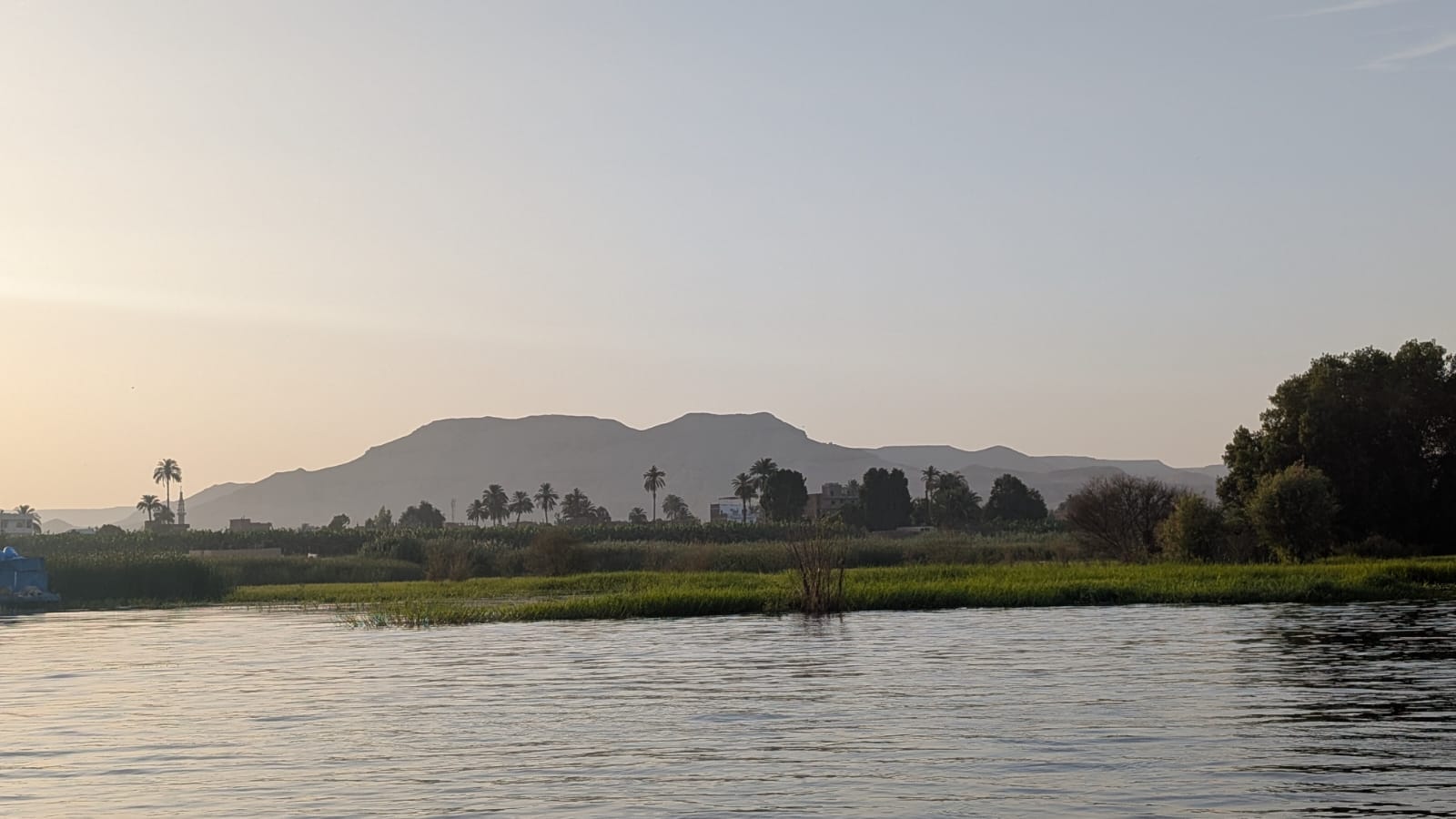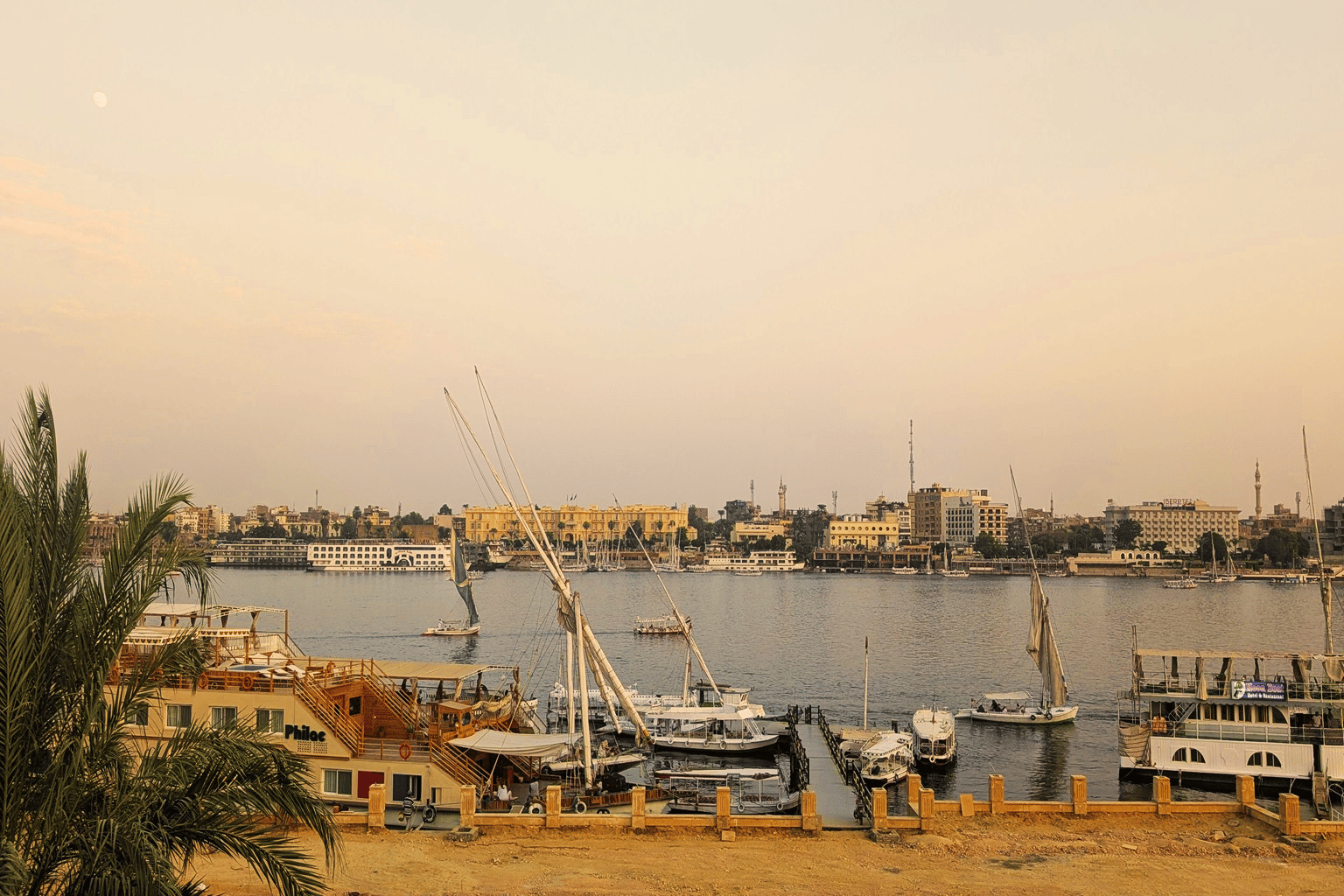


Most first-time visitors assume staying on Luxor’s West Bank will be complicated. In reality, it is usually far simpler than expected once you understand how the Nile crossing works. This guide explains the easiest ways to reach the West Bank from Luxor Airport, the train station, and the East Bank — including taxis, private drivers, ferries, and local boat crossings.
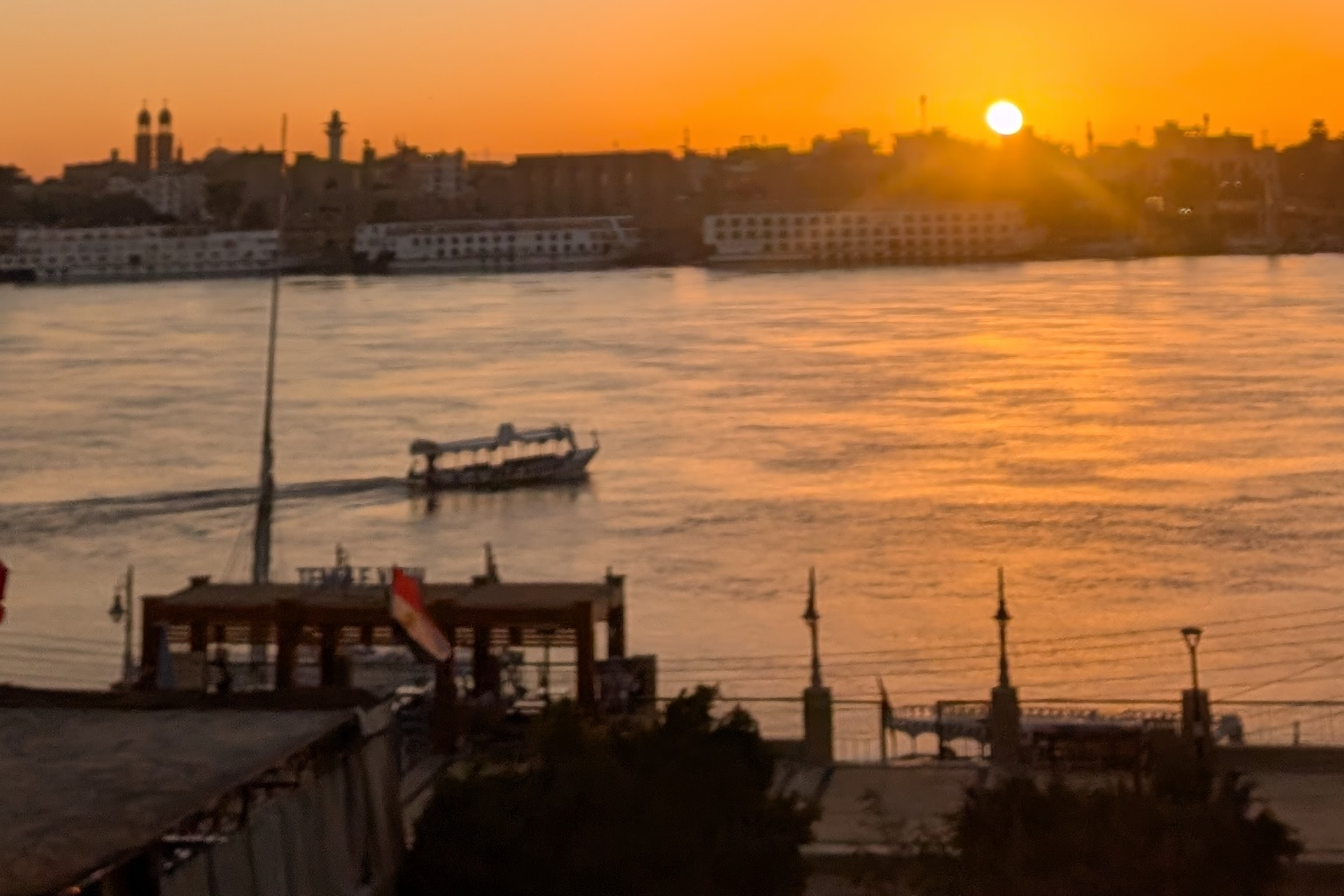
If this is your first time in Luxor, getting to the West Bank can feel unclear at first — but in practice, it’s simple once you know the options.
The part that tends to feel unclear isn't the crossing itself. It's understanding how the whole journey fits together: what you do when you land, how you get to the river (if you're taking the ferry), and how you complete the trip once you're on the other side.
Most travellers get to their hotel via taxi or arranged driver. This guide walks through the main ways to get to the West Bank — and how to get around the West Bank once you're here.
Whether you're weighing up West Bank Luxor or East Bank for your stay, or you've already decided and just need to know how to get here — this guide covers both.
Airport or train station → taxi / ride app / Jalila driver → West Bank hotel
This is the most straightforward way to reach the West Bank, especially if it’s your first time in Luxor.
You leave the airport or train station, get into a car, cross the Nile, and arrive directly at your hotel. There are no transfers or decisions along the way.
Most travellers use this option.
Typical time: 20–40 minutes
Typical cost: 300–600 EGP depending on where you’re coming from and time of day
You can take a taxi outside the airport or station, use a ride app, or arrange a driver in advance.
If you prefer, we can arrange a trusted driver to meet you and bring you directly to the West Bank. This removes the need to negotiate or navigate on arrival.
Contact us to arrange a driver →.
Airport or train station → taxi / ride app → East Bank ferry terminal → local ferry or private boat → West Bank dock → tuk-tuk or taxi to hotel
This is a good option if you’re comfortable navigating independently, but it involves a few more steps than taking a taxi.
From the airport or train station, you first take a taxi to the East Bank ferry terminal (near Luxor Temple). From there, you cross the Nile by public ferry, then take a short taxi ride on the West Bank to your hotel.
The ferry itself is simple to use and runs frequently during the day.
Typical time: 30–60 minutes total
Typical cost: Low — ferry is 25 EGP for tourist one way (As at May 2026), plus short taxi rides on either side
This route feels the most local. Each of those steps is easy on its own. The main consideration is that you're managing three transitions rather than one — which is fine once you know the area, and slightly more to navigate when you're arriving for the first time.
However, if you’re arriving at night, carrying luggage, or prefer a smoother arrival, the taxi or driver option is usually easier
If you’re travelling to Luxor by private car — for example from Hurghada, Aswan, or Cairo — you’ll typically reach the West Bank via the Nile bridge to the north of the city.
This avoids the ferry entirely and brings you directly onto the West Bank road network.
The final stretch into Luxor is usually straightforward, and your driver will take you directly to your hotel.
For most travellers arriving by plane or train, this route isn’t relevant. But if you’re already travelling within Egypt, it’s the standard way to reach the West Bank.
After your first arrival, the way you cross between the banks will depend on what you're doing that day.
If you're heading to the East Bank for a morning at Luxor Temple or an afternoon in the souk, the ferry is the obvious choice — it's quick, cheap, and uses the same route locals use every day. If you're coming back late, a car via the bridge is often easier.
If you're going further afield — Aswan, Abu Simbel, the airport — a direct car makes more sense.
We'll share a trusted local contact when you arrive so you always have a simple way to organise transport, whatever you need.
There are a few ways to cross from the East Bank to the West Bank. This gives you a quick sense of what’s easiest depending on how you like to travel.
Prices vary depending on your starting point and how you negotiate. Ferry and boat options require getting to and from the river, which adds time and a short taxi or tuk-tuk ride.
All cars — whether a pre-arranged driver, a ride app, or a taxi — reach the West Bank via the bridge south of Luxor. This adds a little distance, but it means no transitions, no waiting, and no navigating the river.
For most first arrivals, especially after a long journey, this is the simplest way to come.
The local ferry departs from the East Bank terminal near Luxor Temple.
You can reach it on foot if you're staying nearby, or by taxi or ride app from elsewhere on the East Bank.
The local ferry is how most locals cross between the East and West Bank in Luxor. It's not designed for tourists — it's simply how people get around.
It is a genuine opportunity to experience local life — and one of the few situations in Egypt where the cheapest option is also one of the most interesting.
Cost: Tourist price is 25 EGP per person one way (as of May 2026), note that locals pay a much lower price. You can also buy a return ticket for 50 EGP per person. I personally prefer to pay each way so I can keep my plans flexible.
Crossing time: 5–10 minutes
The ferry doesn't run to a fixed timetable — it waits until it fills before departing. In practice, this means waiting 15–30 minutes, sometimes less if you arrive when it's nearly full. Mornings tend to be busier and faster.
On board, you'll find mothers with babies, men in traditional galabeya, school children curious about visitors. It's an ordinary crossing that can be one of the more memorable parts of a first visit.
The main consideration: you'll need a taxi or tuk-tuk at both ends to complete the journey.
Along the Corniche, boat operators will approach you offering private crossings. This is completely normal.
Typical cost of Private Motor Boat: ~100-200 EGP per boat (negotiate before you board)
Direct crossings are typically 100-150 EGP, if you want to travel further north or south from your departure point, crossings typically cost more depending on how far you want to go.
Private motor boat is typically the most convenient way to cross the Nile. There's no waiting — you go when you're ready.
Most operators are friendly and curious, asking your name and where you're from. This is just conversation. Be warm, be confident on the price, and know there are always other operators if the first offer isn't right.
Like the ferry, you'll still need to get to and from the Nile river on both sides.
Private boat operators do not use a fixed landing point. If you're taking a private crossing, tell the operator roughly where on the West Bank you're heading and they'll aim for the most convenient spot — or simply land where their boat is based. This is normal and part of the negotiation.
The local ferry docks at a fixed landing point on the West Bank, directly across from the East Bank terminal. Unlike private boats — which can land wherever the operator's boat is moored, or wherever you agree — the local ferry always arrives at the same place.
When you step off, you'll find yourself on a short path leading up from the river. From there, two roundabouts give you options in both directions:
To the south, the roundabout leads toward the main village centre of the West Bank — the closest thing to a high street, with small shops, cafés, and local services.
To the north, the roundabout connects toward the quieter residential areas and eventually toward the temple sites.
Tuk-tuks and taxis are usually waiting at both roundabouts. Tell your driver your destination and agree on a price before you get in. If you're not sure which direction you need, show them Google Maps — a visual is clearer than a name or address.
InDrive is the most commonly used ride app in Luxor. You agree on a price before the trip begins, which removes most of the uncertainty.


InDrive prices tend to reflect local rates. Occasionally a driver may ask for more on arrival — if that happens, step out calmly, hand over the agreed amount, thank them, and move on. It's rare, and this is the simplest way to handle it.
When a journey goes smoothly, a small tip is a genuinely appreciated gesture. 10–50 EGP is normal for most rides.
Helpful to know: drivers often don't carry change, so small notes help.
Taxis are easy to find and don't require an app. They do require negotiation, and initial quotes are often significantly higher than what's fair.
A note from my own early days in Luxor: sitting outside a café near Luxor Temple, I was quoted 4,000 EGP for a taxi to a cruise terminal just south of the city centre — a journey that should have cost 200–300 EGP. When I questioned it, the driver was aggressive and entirely unapologetic. I walked away, found another taxi within minutes, and paid 300 EGP.
That's the most useful thing to know: there is always another taxi. You don't need to negotiate from a position of desperation, because the option to walk away is always real.
Once you've crossed, you'll usually need onward transport.
Tuk-tuk: ~100–200 EGP from the ferry terminal, depending on distance. Shorter hops within the village cost less; longer rides toward the temples cost more.
Taxi: ~150–350 EGP for most West Bank journeys. Taxis cost roughly 1.5–2x the equivalent tuk-tuk fare and make more sense for longer distances or if you're carrying bags.
Tuk-tuks are quicker for short distances and more local in feel. They're less comfortable than a car, but taking one at least once is part of the West Bank experience.
These ranges cover everyday West Bank movement — not full-day excursions or temple tours, which are priced differently. As always, agree the price before you get in.
A practical note: drivers in Luxor often don't use formal addresses and may not recognise hotel names or be confident with maps. The simplest approach is to have Google Maps open, show the destination visually, and use simple hand signals if needed. It's not difficult — just different from what most visitors are used to.
If you'd prefer not to think about any of this part either, we can arrange a driver for the onward journey too.
You've seen how it works. And also where it can feel slightly unclear.
If you'd prefer not to think about any of this on your first arrival, we can arrange a driver for you. We keep a small, curated list of people we know personally and trust. They arrive early, communicate clearly, and don't rush or pressure. You won't need to negotiate, explain, or navigate anything.
You'll simply arrive.
Once you're here, we'll share a trusted local contact you can reach at any time — so you always have a reliable way to move around the West Bank.
Most guests choose this for their first crossing, then explore the other options once they've settled in.
Contact us to arrange a driver.
The crossing itself takes minutes. But something shifts.
The East Bank is dense and active. The West Bank opens out — fields, space, slower movement. It's not silent. But it is easier to settle into.
West Bank Luxor or East Bank: the question of which side to stay on is worth thinking about before you arrive.
This article focuses on the crossing itself. If you're still deciding where to base yourself, [the West Bank vs East Bank guide] (coming soon) will cover that in full.
Yes — once you understand the options, it's straightforward. Most visitors either take a taxi or ride app via the bridge, or cross the Nile by local ferry or private boat. The first time can feel slightly unclear, but after one or two crossings it becomes simple.
The local ferry costs 25 EGP per person one way (as of May 2026). The crossing takes 5–10 minutes. You may wait 20–30 minutes for it to fill before it departs.
The ferry doesn't follow a fixed timetable — it departs when it's full. During busy morning hours, this can be every 10–15 minutes. At quieter times, you may wait longer. Budget 20–30 minutes to be comfortable.
Uber isn't widely used in Luxor. Most visitors use InDrive, which lets you agree on a price before the journey begins. Taxis are also common but require negotiation.
A direct car via the bridge — whether pre-arranged, by ride app, or taxi — is the simplest option. It's door-to-door with no transitions.
For your first arrival, yes — it removes negotiation, navigation uncertainty, and the need to coordinate multiple steps. Many guests do this for the first journey and then explore other options once they're comfortable.
10–100 EGP is normal depending on the journey. Carry small notes; drivers often don't have change.
No — it's directly across the Nile. By boat: 5–10 minutes. By car via the bridge: 20–30 minutes. Close in distance, noticeably different in feel.
---
The prices and experiences in this guide are based on my own time living on the West Bank. Transport costs change, and individual experiences vary. If something you've encountered feels significantly different from what's described here, we'd love to know so we can keep this guide as relevant and useful as possible - you can email us at hello@jalilahotel.com